SYSTEMS THINKING!
ARMY ANT SUPERORGANISM
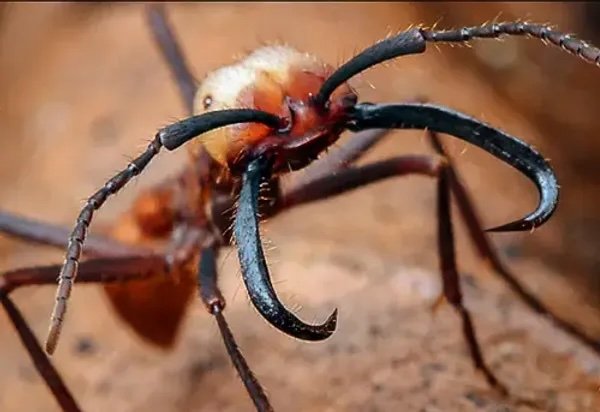
Eciton burchelli soldier ant
Photo credit: Alex Wild Diversity of Insects
CLASS ACTIVITY — ANT COLONY SIMULATION
As soon as the class settles, without comment, show this Building a New Home video from BBC Earth. Follow this with a public reading of the Geoffrey West quote by a student volunteer. After soliciting any spontaneous insights—or even better, any personal anecdotes about ants—take a moment to appreciate the award-winning army ant bivouac photo. This might also be a good time to introduce the “superorganism” concept.
“No one is in charge.
Ant colonies are built without forethought and without the aid of any single mind or any group discussion or consultation. There is no blueprint or master plan. Just thousands of ants working mindlessly in the dark moving millions of grains of earth and sand to create these impressive structures. This feat is accomplished by each individual ant obeying just a few simple rules mediated by chemical cues and other signals, resulting in an extraordinarly coherent collective output.
It is almost as if they were programmed to be microscopic operations in a giant computer algorithm.”
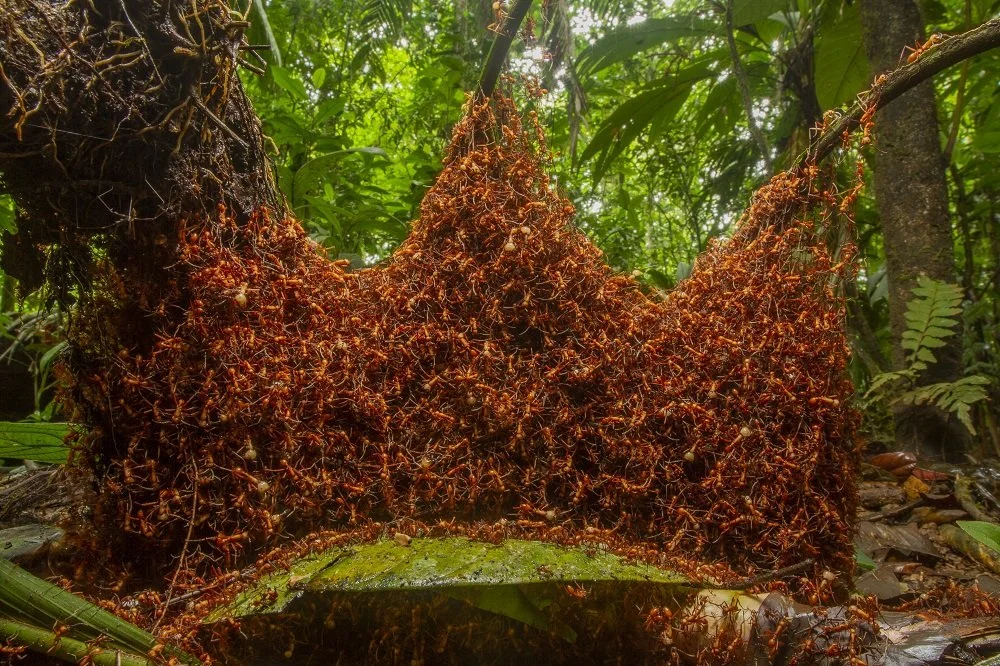
Cathedral-shaped, interlinked bivouac of army ants.
Photo credit: Daniel Kronauer, neuroscientist and “ant paparazzo” at Rockefeller University in New York.
Let the fun begin—
Floaino Ant Colony Simulation!
Next, announce that students will explore the Floaino Ant Colony Simulation—working collaboratively in pairs. Allow a full six minutes, more if needed. Here is the link:
https://floaino.com/simulations/ant-colony
Students should persist in their explorations, repeatedly using the “Reset Simulation” button to discover for themselves (incrementally) what is actually going on. Food sources are added by clicking anywhere on the canvas. A robust initial approach is seeing how the algorithm works with just one ant, then just a few ants, then up to a hundred ants!
It is also worth manipulating the “Evaporation Rate,” which varies the strength of the pheromone trails. The “Wander Chance” determines the adventurousness of the ants.
When the time seems right, announce jarringly, “Times up!” Tell students to close their devices. Pause for a moment, then ask the familiar generative question:
“What just happened?”
Initial student contributions are likely to be quite literal—based on precisely what occurred during the simulation. Steer the conversation towards exploring how on earth complex behaviors emerge from the interactions between individual ants seemingly without central control? The following questions may add extra value.
How well-named is “the Queen” in an ant colony?
The Floaino model is a simplification—how useful is it?
And here are two whimsical quotes that may, or may not, add value.
“All models are wrong, but some are useful.
”
“Karl Marx was right, socialism works, it is just that he had the wrong species”
TRANSCENDING THE DEATH SPIRAL
Students may mention viral, TikTok-style, short-form videos about “ant mill” or “death spiral.” This one from FactFats has good imagery and avoids silliness.
In her book, Complexity a Guide Tour (2009: 3-4) Melanie Mitchell quotes Nigel Franks who is Emeritus Professor of Animal Behavior and Ecology at the University of Bristol.
“The solitary army ant is behaviorally one of the least sophisticated animals imaginable,” and “If 100 army ants are placed on a flat surface, they will walk around and around in never-decreasing circles until they die of exhaustion. “ Yet put half a million of them together, and the group as a whole becomes what some have called a “superorganism” with “collective intelligence.”
This video showcases Professor Franks in his lab. His team attaches tiny computer chips to individual ants in order to investigate nuances of their communication and collective decision-making.
Collective sophistication emerging mysteriously
from individual simplicity
Here is Professor Franks again:
“I have studied E. burchelli [a common species of army ant] for many years, and for me the mysteries of its social organization still multiply faster than the rate at which its social structure can be explored.”
Can a systems meta-thinking approach to ant colonies transfer to navigating the complexity of human endeavor?
We glimpsed ants in their natural tropical habitat,. We had fun with a simplified but informative colony simulation. We glimpsed jaw-dropping, chip-enabled, frontier lab science.
But, this is TOK! The intention here is not to teach students nerdy, fascinating facts about army ants. The critical point here is that ant social organization, and emergent collective intelligence, is being used as an exemplar—a microcosm—for acquainting TOK students with complex adaptive systems in general.
Is this approach working for your students? Let’s see… Randomly assign students to intimate discussion groups. Challenge them with some, or all, of the following:
IN PROGRESS
— CODA —
ENORMOUS, JUICY,
SYSTEMS THINKING QUESTION:

Why is a living cell like Paris, and also not like Paris?
Photo credit: Paris Guide