OPTIONAL THEME:
KNOWLEDGE AND RELIGION
RELIGIOSITY AND FAITH
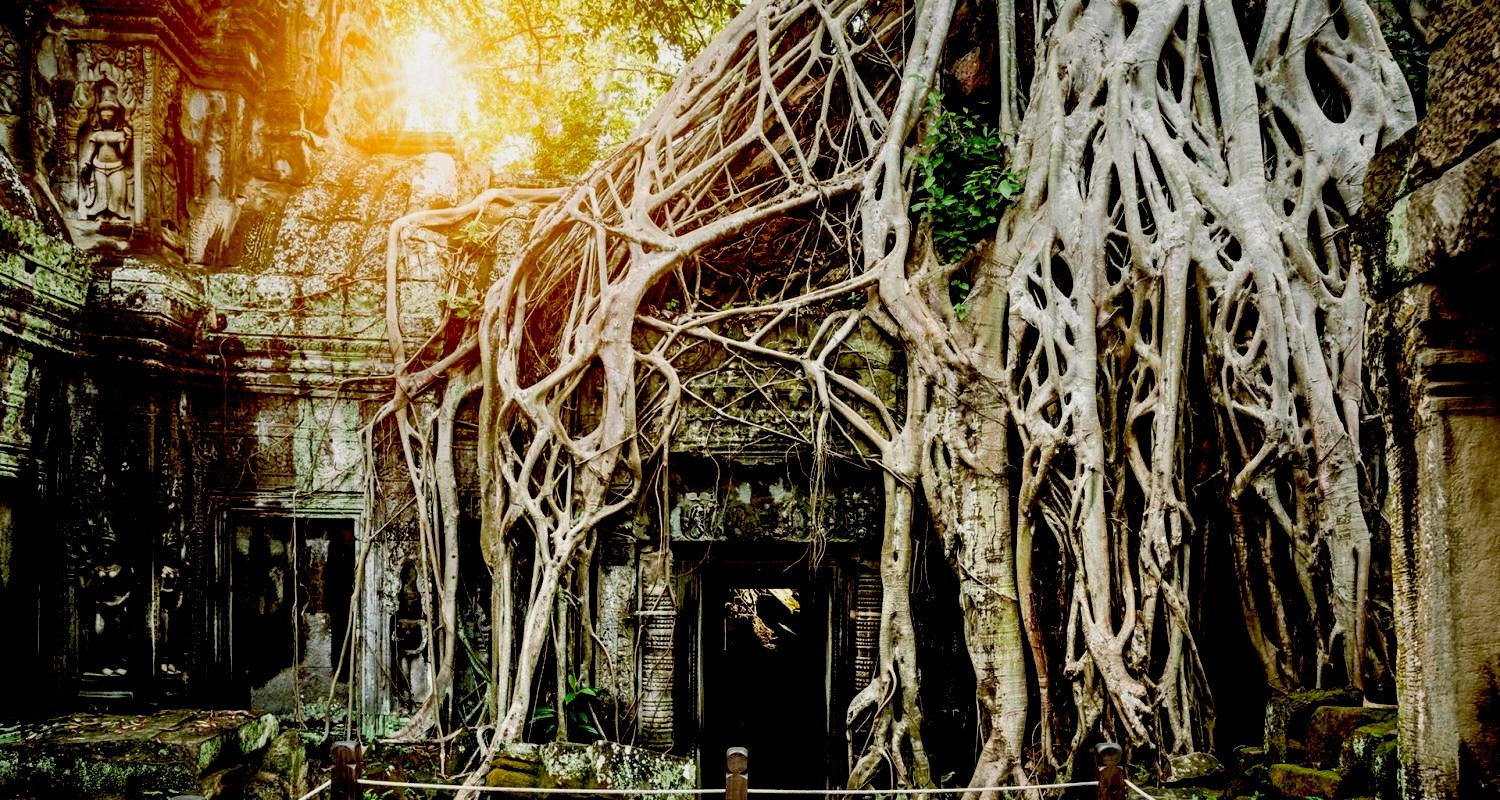
Part of the Angkor Wat temple complex in Cambodia — the largest religious edifice on earth!
CLASS ACTIVITY -
Is there such a thing as relgion?
These class activities build on the introduction to the Variety of Religious Experience. Whilst the different religions around the world have family resemblances, it is quite slippery to actually define religion.
Religions are intriguing and multifarious. Most—but not all—have a god (or gods) and, for many religions, belonging can be more important than belief.
In the Belief without evidence unit in the Knowledge and the Knower Core we started by acknowledging that in the everyday, secular world, “faith” is often used as a synonym for “trust.” However, in most denominations of Christianity and Islam “faith” is central and has a specific meaning. In this context faith means all-or-nothing belief in, and personal commitment to, God or Allah. This distinction is a powerful example of the Polysemy of language.
A TRICK QUESTION ABOUT RELIGION
Begin this unit by showing in full, Ghanaian philosopher, Kwame Anthony Appiah's 2014 TED talk entitled “Is Religion Good or Bad?”
Appiah is discombobulating. He states that the Dalai Lama is an atheist. He also mentioned a Rabbi who said the great thing about being Jewish is that you do not have to believe in God; you have to believe in being Jewish! After the provocative Appiah video, students should tackle the following Knowledge Questions in groups of three. Allow a timed five minutes for each.
Well, is there such a thing as religion?
Is belief in God a pre-requisite for being religious
Going deeper—
ATTEMPTING TO DEFINE RELIGION
Randomly nominate six “volunteers.” The first should read aloud this succinct definition of religion from the BBC website:
Religion can be explained as a set of beliefs concerning the cause, nature, and purpose of the universe, especially when considered as the creation of a superhuman agency or agencies, usually involving devotional and ritual observances, and often containing a moral code governing the conduct of human affairs.
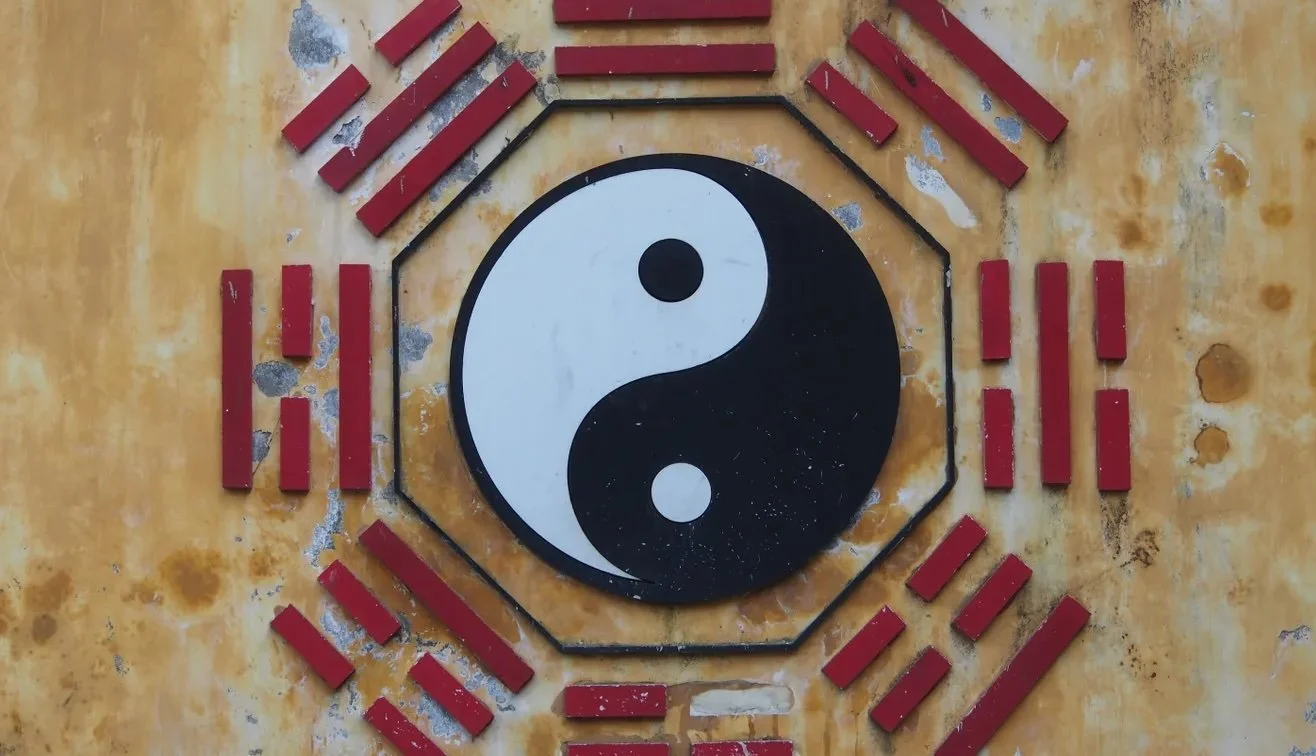
Ying Yang symbol from temple complex in the Wudang mountains in Hubei, China. The symbol evokes the principle that all things exist as inseparable and contradictory opposites!
Photo source: Pocono Record
Ask the remaining five “volunteers” to stand in line (just for the fun of it— make it according to shoe size, smallest first). When the teacher gives the signal thay should each read a paragraphs of Jared Diamond’s Religion definition. Diamond offers a broader and more detailed distillation than the BBC. His constellation of five sets of attributes, vary in strength amongst the world’s religions—including the traditional religions found in Indigenous Knowledge Systems:
Religion is the belief in a postulated supernatural agent for whose existence our senses can’t give us evidence, but which is invoked to explain things of which our senses do give us evidence.
They are social movements of people who identify themselves as sharing deeply held beliefs.
Their adherents make costly or painful sacrifices that convincingly display to others the adherents’ commitment to the group.
Belief has practical consequences for how people should behave.
Many religions teach that supernatural agents not only reward virtuous rule-obeying people and punish evil-doers and rule-breakers, but also can be induced by prayers, donations and sacrifices to intervene on behalf of mortal petitioners.
Diamond, Jared (2012: 329-331) The World Until Yesterday: What Can We Learn From Traditional Societies? Penguin, New York.
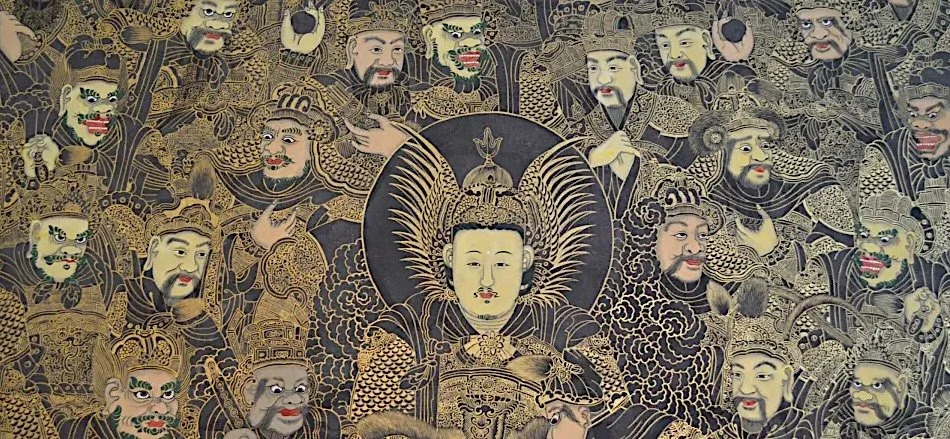
Shinjung Taenghwa — Altar Painting of Guardian Deities at the Ansimsa Temple in Wanju, Korea.
Image source: Dale’s Korean Temple Adventures
A STORY FROM PAPUA NEW GUINEA
Begin this next section by inviting students to quickly Google:
Roughly how many languages are there in the world?
How many languages are spoken in Papua New Guinea?
The point will be driven home further if they look up the population of Papua New Guinea and compare the ratios mathematically.
To add a indigenous cultures perspective, students should first read in silence the following narrative from Geography professor and author, Jared Diamond. Afterwards it should be read aloud, in bold, story telling mode including hand gestures, by a student who has proven theatrical talent. (The performer could be given the text well in advance.)
This origin story, which has some parallel with the biblical story, the Tower of Babel, could be included with the What can we learn from traditional societies? unit in Indigenous Knowledge Systems.
Printable Pdf.
In the beginning, all people lived around a great ironwood tree in the jungle, speaking the same language. One man whose testes were enormously swollen from infection with a parasitic worm spent his time sitting on a branch of the tree, so that he could rest his heavy testes on the ground. Out of curiosity, animals of the jungle came up and sniffed at his testes. Hunters then found the animals easy to kill, and everyone had plenty of food and was happy.
Then, one day, a bad man killed a beautiful woman’s husband, in order to get the woman for himself. Relatives of the dead husband attacked the murderer, who was defended in turn by his own relatives, until the murderer and his relatives climbed into the ironwood tree to save themselves. The attackers tugged on lianas hanging from one side of the tree, in order to pull the tree’s crown down towards the ground and get at their enemies.“Finally, the lianas snapped in half, causing the tree to spring back with tremendous force. The murderer and his relatives were hurled out of the tree in many different directions. They landed so far away, in so many different places, that they never found each other again. With time, their languages became more and more divergent. That is why people today speak so many different languages and cannot understand each other, and why it is hard work for hunters to catch animals for food.
That story was related to me by Sikari people, a tribe of six hundred New Guineans.
Diamond, Jared (2012: 209) The World Until Yesterday: What Can We Learn From Traditional Societies? Penguin, New York.
RETURNING TO THE KNOWLEDGE QUESTIONS
We just added two austere attempts at definition and the astonishing Papua New Guinea languages origin story into the mix. Let’s revisit our original knowledge questions, this time with a full class discussion.
Well, is there such a thing as religion
Is belief in God a pre-requisite for being religious?

Dani tribe chief carrying smoke-preserved ancestor. The Dani live in a remote area of the Papuan central highlands. Photo: Getty.