
KNOWLEDGE AND THE KNOWER—
WHAT COUNTS AS KNOWLEDGE?
PARABLE OF THE BLIND MEN AND THE ELEPHANT

Multiple blind men ineptly perusing a huge elephant. Digital image generated in May 2023 by the site author using DALL·E at the OpenAI site.
CLASS ACTIVITY i
Ready… FIRE, AIM! — REVISITED
Start by reminding students about the very first activity performed in our TOK class—Explore mystery objects by touch alone. Recall that we attempted to identify a plastic Octopus, a Möbius strip made with modeling clay, and a fossilized knuckle bone of extinct Patagonia horse with varying degrees of success.
Today’s ice-breaking activity echoes that first session. Ask students to come to the front of the class, one-by-one, in silence, to identify, by touch alone, a mechanical part that has been hidden in a pillow case.

Front brake disc from a 1994 BMW K75 motorcycle and pillow case, photographed in the author’s kitchen
The teacher should bring in any object that is part of a larger whole. I found a brake disc from a 1994 BMW K75 motorcycle conveniently to hand. But you could choose any object. A bicycle chain, a microscope objective, or even a chess piece are familiar objects that come to mind.
Without revealing the object or allowing any further comment from students, move on swiftly to the next activity.
CLASS ACTIVITY I - THE POEM
Select nine willing students for a dramatic but light-hearted reading of the John Godfrey Saxe poem. The class will no doubt recognize the Blind Men and the Elephant story from childhood picture books.
The Blind Men and the Elephant
I
It was six men of Indostan
To learning much inclined,
Who went to see the Elephant
(Though all of them were blind),
That each by observation
Might satisfy his mind.
II.
The First approached the Elephant,
And happening to fall
Against his broad and sturdy side,
At once began to bawl:
"God bless me!—but the Elephant
Is very like a wall!"
III.
The Second, feeling of the tusk,
Cried: "Ho!—what have we here
So very round and smooth and sharp?
To me 't is mighty clear
This wonder of an Elephant
Is very like a spear!"
IV.
The Third approached the animal,
And happening to take
The squirming trunk within his hands,
Thus boldly up and spake:
"I see," quoth he, "the Elephant
Is very like a snake!"
V.
The Fourth reached out his eager hand,
And felt about the knee.
"What most this wondrous beast is like
Is mighty plain," quoth he;
"'T is clear enough the Elephant
Is very like a tree!"
VI.
The Fifth, who chanced to touch the ear,
Said: "E'en the blindest man
Can tell what this resembles most;
Deny the fact who can,
This marvel of an Elephant
Is very like a fan!"
VII.
The Sixth no sooner had begun
About the beast to grope,
Than, seizing on the swinging tail
That fell within his scope,
"I see," quoth he, "the Elephant
Is very like a rope!"
VIII.
And so these men of Indostan
Disputed loud and long,
Each in his own opinion
Exceeding stiff and strong,
Though each was partly in the right,
And all were in the wrong!
MORAL.
So, oft in theologic wars
The disputants, I ween,
Rail on in utter ignorance
Of what each other mean,
And prate about an Elephant
Not one of them has seen!
John Godfrey Saxe (1872)
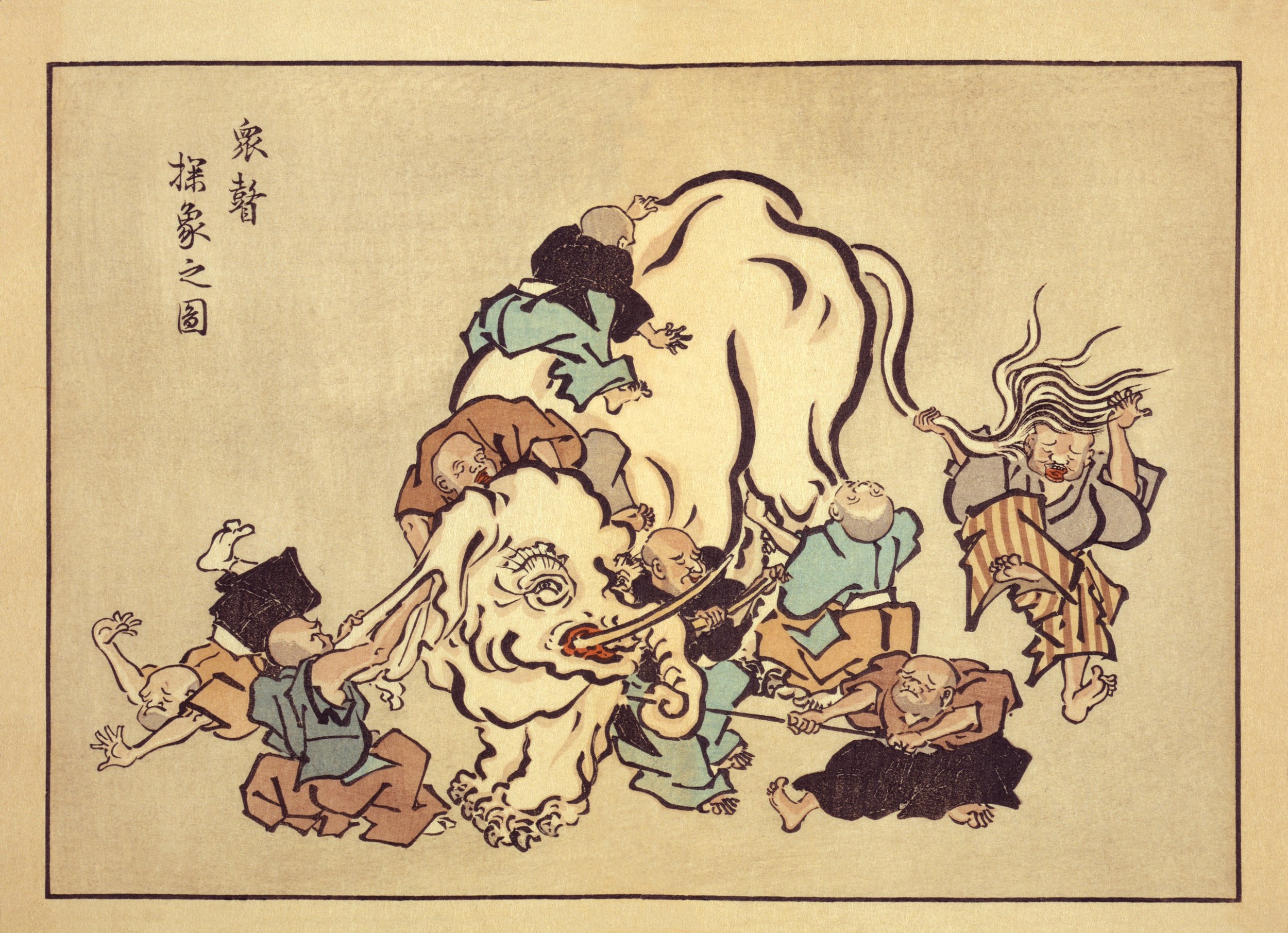
Hanabusa Itchō (1652–1724) Blind monks examining an elephant, Ukiyo-e woodcut print.
Pachydermal caricature
Next, to capture the spirit of the poem, invite the class to sketch individually outrageous cartoons of an elephant—with a wall, a spear, a snake, a fan, a tree, and a rope in place of their respective anatomical features.

Elephant eye. Photo Credit: Jiri Foltyn / Shutterstock
CLASS DISCUSSION—WARM-Up QUESTIONS
Elephant societies are matriarchal because all the males leave the herd when they become sexually mature. Elephants have a 22 month gestation period. Elephant calves require constant maternal care for at least six months. Elephants have 2 nipples. Elephants communicate subsonically across many kilometers. Can you suggest an additional fun fact about elephants not perceived by the blind men?
Differentiate between Loxodonta africana and Elephas maximus?
What was in the pillow case?
GOING DEEPER—Tougher questions
After adding a fun twist by showing the short video, delve deeper with the following questions:
What insights into knowledge acquisition can be made from the Parable of the Blind Men and the Elephant?
Does it matter if how we obtain knowledge happens in “bubbles,” where some information and voices are excluded?
What parallels can be made with regard to being human when comparing the Blind Men and the Elephant, Plato’s Allegory of the Cave, and The Truman Show (2008)?
CLASS ACTIVITY II - HOLISM VS. REDUCTIONISM
Students studying IB Biology and Environmental Systems and Society (ESS) will be very familiar with the notion of an interacting hierarchy of complexity as a frame for understanding life in the biosphere at various scales. Begin by sharing the following image with the class.

Next, ask a student to read out this quote from Aristotle that has been reduced to the familiar “the whole is greater than the sum of the parts.”
“Whenever anything which has several parts is such that the whole is something over and above its parts, and not just the sum of them all, like a heap, then it always has some cause.”
Next arrange students in pairs and provide note paper. Inform them that they now have a timed 10 minutes to write by hand a signed, collaborative response to the following prompt.
Using a few real-life examples, differentiate between reductionism and holism.
After collecting the papers, and if time permits, enjoy the Plato’s Cave cartoon video at the bottom of this page.
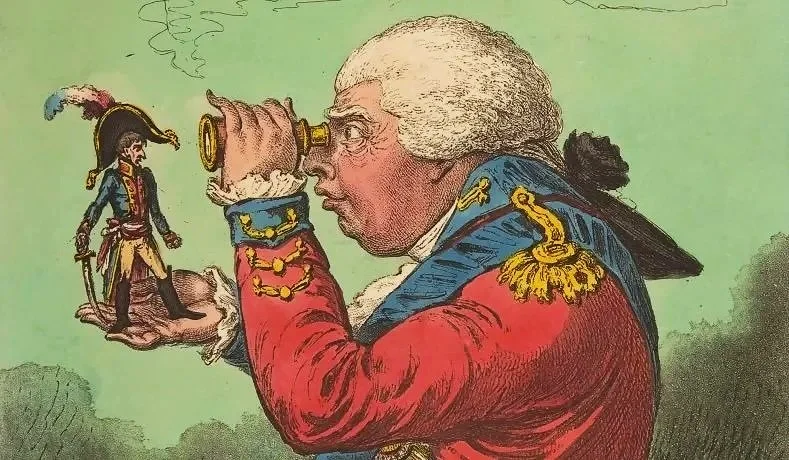
James Gillray (1803) The King of Brobdingnag and Gulliver. Hand-colored etching and aquatint. Metropolitan Museum of Art, New York.
Further explorations of holistic and reductionist understanding can be found at Systems thinking and Consilience of knowledge in The Human Sciences.
PLATO’S CAVE REVISITED
“The safest general characterization of the European philosophical tradition is that it consists of a series of footnotes to Plato.”